Search This Blog

Showing posts with label obstetrics. Show all posts

Thursday, April 5, 2018

12 Steps of Cesarean section


Preoperative preparation
·         Investigations: Blood : Hb, Coagulation profile, Serology, Blood group, Renal Fucntion test
·         Arrange II pint of whole blood and Cross match
·         Take Consent
·         Inform Anaesthesiologist
·         Inform Neonatologist/ Pediatrician

Intra operative preparations
·         Position: Supine
·         Wide bore canulation
·         Catherization
·         Preoperative medications including Antibiotics, gastroprotective agents
·         FHS Monitoring
·         Anaesthesia: Spinal/ General

Surgical Steps
Painting and draping  Lower abdominal inscision Soft tissue dissection and abdominal cavity reached. Doyen’s retracter is introduced and abdominal cavity is packed.  Identification of lower uterine segment and extraperitoneal incision is made over the uterine muscle. Membarane is ruptured, liquor suctioned and muscles spilt across. Fetal head  identified, doyen’s retracter removed and  baby  delivered. Doyen’s retractor reintroduced. Controlled cord traction of placenta.  Wound margin picked using hemostatic clamp  Uterine incision is sutured in 3 layers continuously using absorbable suture. Skin is closed in layers and dressing done. Wound packed.
12 steps of Cesarean section
1.       Painting and Draping
2.       Incision : Lower abdominal (Pfennestial) / midline vertical/ paramedian vertical
3.       Soft tissue dissection and opening of peritoneal cavity
4.       Doyen’s retracter is introduced and abdominal cavity is packed.
5.       Identification of Lower uterine segment and extraperitoneal incision is made over the uterine muscle.
6.       Membarane is ruptured, liquor suctioned and muscles spilt across.
7.       Fetal head is identified, Doyen’s retracter removed and  baby is delivered. Cords clamped and cut. Baby transferred.
8.       Doyen’s retractor reintroduced.
9.       Controlled cord traction performed and placenta removed. IV oxytoics provided.
10.   Wound margin picked using four Allis Forceps or green Armytage hemostatic clamp
11.   Uterine incision is sutured in 3 layers continuously using absorbable suture.
12.   Skin is closed in layers and dressing done. Wound packed.

Post operative care
·         Monitor: BP, Pulse, RR, Temperature, Fluid Input, Urine Output, Abdominal distension
·         Provide IV fluid, analgesics, Antibiotics, Oxytoxics
·         Breastfeed as early as mother is stable.
·         Ambulate as early as mother can tolerate
·         Start on sips as bowel sound appears, increase gradually to soft to solid food over 2-3 days.
·         Avoid coughing, straining and exertional work.
·         Wound dressing every 3-4 days and suture removal on Day 5-7.
·         Patient can be discharged once patient is stable and can take care of wound and diet.

Tuesday, October 31, 2017

Important Days of Commemoration of Public Health Interest (UN WHO endorsed and not endorsed)

Days of Public Health Interest Endorsed, Adopted and Observed by United Nations and its Agencies

Date
DAY
4th February
World Cancer Day
8th March
International Women’s Day
21st march
World Down Syndrome Day
24th March
World TB Day
2nd April
World Autism Awareness Day
7th April
World Health Day
25th April
World Malaria Day
28th April
World Day For Safety At Work
23rd May
International Day To End Obstetric Fistula
31st may
World No Tobacco Day
5th June
World Environment Day
13th June
International Albinism Awareness Day
14th June
World Blood Donor Day
21st June
World Yoga Day
11th July
World Population Day
28th July
World Hepatitis Day
28th September
World Rabies Day
10th October
World Mental Health Day
13th October
International Day For Disaster Reduction
16th October
World Food Day
14th November
World Diabetes Day
19th November
World Toilet Day
19th November (3rd Sunday of November)
World Day Of Rememberance Of Road Traffic Victims
1st December
World AIDS Day
3rd December
International Day Of Persons With Disabilities


Last week of April  
World Immunization Week
1-7 August
World Breastfeeding Week
13-19 November 
World Antibiotic Awareness Week

Http://Www.Un.Org/En/Sections/Observances/International-Weeks/Index.Html
http://www.who.int/mediacentre/events/official_days/en/

4TH FEBRUARY  World Cancer Day 8TH MARCH  International Women’s Day  21ST MARCH World Down Syndrome Day  24TH MARCH  World TB Day  2ND APRIL  World Autism Awareness Day  7TH APRIL World Health Day  25TH APRIL  World Malaria Day  28TH APRIL  World Day For Safety At Work  23RD MAY  International Day To End Obstetrics Fistula  31ST MAY  World No Tobacco Day  5TH JUNE  World Environment Day  13TH JUNE  International Albinism Awareness Day  14TH JUNE  World Blood Donor Day  21ST JUNE  World Yoga Day  11TH JULY  World Population Day  28TH JULY  World Hepatitis Day  28TH SEPTEMBER  World Rabies Day  10TH OCTOBER  World Mental Health Day  13TH OCTOBER  International Day For Disaster Reduction  16TH OCTOBER  World Food Day  14TH NOVEMBER  World Diabetes Day  19TH NOVEMBER  World Toilet Day  19TH NOVEMBER (3RD SUNDAY OF NOVEMBER) World Day Of Rememberance Of Road Traffic Victims 1ST DECEMBER World AIDS Day  3RD DECEMBER International Day Of Persons With Disabilities
UN endorsed Days 

Other Days of Public Health Interest not endorsed by UN

Date
Day
February 11
World Day of Sick
February 15
World Cholangiocarnioma Day
March 12
World Glaucoma Day
March 20
World Oral Health Day
April 17
World Hemophilia day
May 8
World Redcross Day
May 12
International Nurses day
May 18
World AIDS vaccine day
1st Tuesday in March
World Asthma Day
June 26
World Vitiligo Day
September 28
International Safe Abortion Day
September 29
World Heart day
October 2
World Cerebral Palsy day
October 10
World Mental health Day
October 11
World Obesity Day
October 13
World Thrombosis Day
October 15
Global Hand Washing day
October 18
World Vasectomy day
October 20
World Osteoporosis Day
October 29
World Stroke day
2nd Thursday in October
World Sight Day
November 8
International Day of Radiology
November 12
World Pneumonia day
November 15
World COPD awareness Day
November 17
World Prematurity day
November 26
Anti Obesity Day
https://en.wikipedia.org/wiki/List_of_international_observances

FEBRUARY 11 World Day of Sick  FEBRUARY 15  World Cholangiocarnioma Day  MARCH 12  World Glaucoma Day  MARCH 20 World Oral Health Day  APRIL 17  World Hemophilia day  MAY 8 World Redcross Day  MAY 12 International Nurses day  MAY 18  World AIDS vaccine day  1ST TUESDAY IN MARCH  World Asthma Day  JUNE 26 World Vitiligo Day  SEPTEMBER 28  International Safe Abortion Day  SEPTEMBER 29  World Heart day  OCTOBER 2 World Cerebral Palsy day  OCTOBER 10  World Mental health Day  OCTOBER 11 World Obesity Day  OCTOBER 13 World Thrombosis Day  OCTOBER 15  Global handwashing day  OCTOBER 18 World Vasectomy day  OCTOBER 20 World Osteoporosis Day  OCTOBER 29 World Stroke day  2ND THURSDAY IN OCTOBER  World Sight Day  NOVEMBER 8  International Day of Radiology  NOVEMBER 12  World Pneumonia day  NOVEMBER 15  World COPD awareness Day  NOVEMBER 17  World Prematurity day  NOVEMBER 26  Anti Obesity Day
Days Not endorsed by UN 

Sunday, September 17, 2017

Indications for Cesarean Section: Mnemonics


Cesarean Section is the delivery of the product of conception after the period of viability by making an incision in the anterior wall of the Uterus.

Cesarean section step by step procedure (Flowchart)


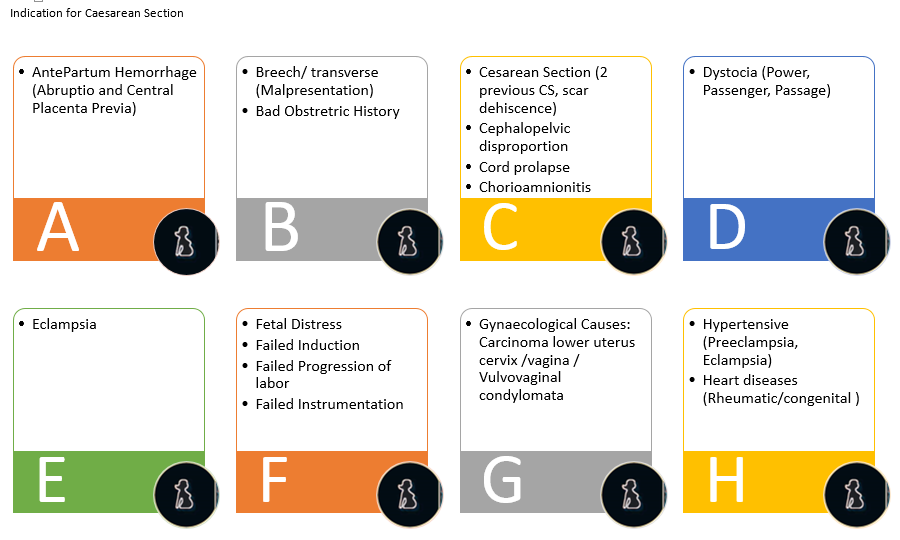
A  AntePartum Hemorrhage (Abruptio and Central Placenta Previa) B  Breech/ transverse (Malpresentation)  Bad Obstretric History  C  Cesarean Section (2 previous CS, scar dehiscence)  Cephalopelvic disproportion  Cord prolapse  Chorioamnionitis D  Dystocia (Power, Passenger, Passage)     E  Eclampsia F  Fetal Distress  Failed Induction  Failed Progression of labor   Failed Instrumentation G  Gynaecological Causes: Carcinoma lower uterus cervix /vagina / Vulvovaginal condylomata     H   Hypertensive (Preeclampsia, Eclampsia)  Heart diseases (Rheumatic/congenital )
Indication for Cesarean Section:  Mnemonic

Points to be noted are
1.       Product of Conception can be living or dead.
2.       Before viability, if POC is removed by undergoing surgical Procedure it will be called Hyste-RO-tomy (Not Hyste-REC-tomy) and not caesarean section.
3.       The delivery is made by making an incision on the anterior wall of the UTERUS. Though incision on anterior wall of the ABDOMEN is necessary to reach the anterior wall of uterus, the definition of cesarean section will be incomplete just by mentioning the anterior abdominal wall. So delivery of ruptured uterus and abdominal pregnancy is not C section.
1. Central Placenta Previa 2. Contracted Pelvis/ Absolute Cephalopelvic disproportion 3. Advanced Carcinoma of Cervix 4. Pelvic masses Causing obstruction of pathway. 5. Vaginal Canal Obstruction Stenosis or atresia  6. Umbilical Cord Prolapse 7. Transverse lie 8. Eclampsia and HELLP Syndrome (Life threatening condition)
Absolute Indication For C Section

Absolute Indications for Cesarean section.

1.       Central Placenta Previa
2.       Contracted Pelvis/ Absolute Cephalopelvic disproportion
3.       Advanced Carcinoma of Cervix
4.       Pelvic masses Causing obstruction of pathway.
5.       Vaginal Canal Obstruction Stenosis or atresia
6.       Umbilical Cord Prolapse
7.       Transverse lie
8.       Eclampsia and HELLP Syndrome (Life threatening condition)
              
 Learn about history taking in Obstetrics.


Relative Indications

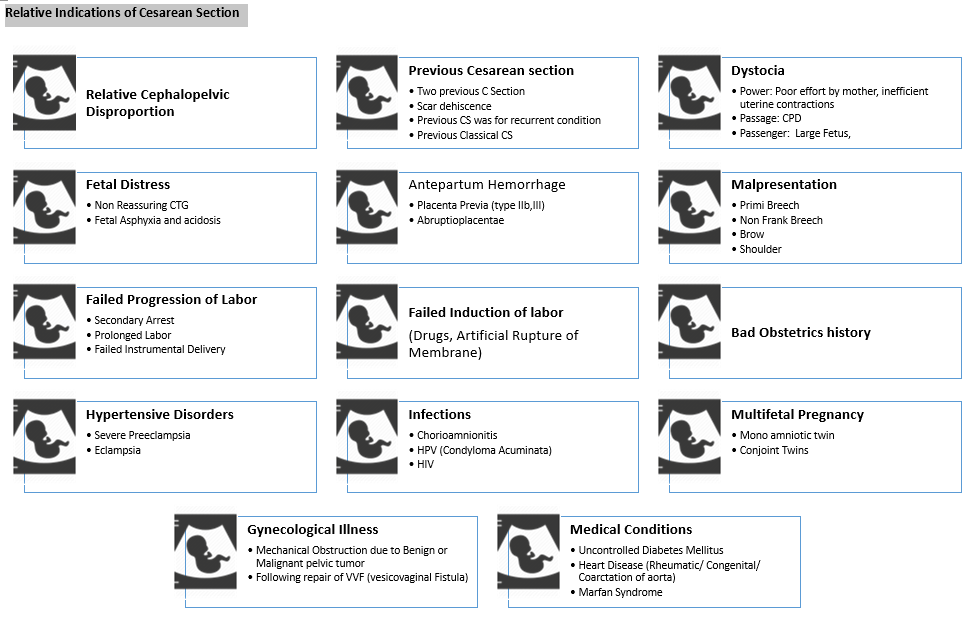
1. Relative Cephalopelvic Disproportion  2. Previous Cesarean section  a. Two previous C Section  b. Scar dehiscence c. Previous CS was for recurrent condition  d. Previous Classical CS 3. Dystocia  a. Power: Poor effort by mother, inefficient uterine contractions b. Passage: CPD c. Passenger:  Large Fetus,  4. Fetal Distress  a. Non Reassuring CTG  b. Fetal Asphyxia and acidosis 5. Antepartum Hemorrhage a. Placenta Previa (type IIb,III) b. Abruptioplacentae 6. Malpresentation  a. Primi Breech  b. Non Frank Breech  c. Brow  d. Shoulder 7. Failed Progression of Labor a. Secondary Arrest  b. Prolonged Labor  c. Failed Instrumental Delivery  8. Failed Induction of labor (Drugs, Artificial Rupture of Membrane) 9. Bad Obstetrics history  10. Hypertensive Disorders a. Severe Preeclampsia b. Eclampsia 11. Infections  a. Chorioamnionitis b. HPV (Condyloma Acuminata) c. HIV  12. Multifetal Pregnancy  a. Mono amniotic twin  b. Conjoint Twins  13. Gynecological Illness a. Mechanical Obstruction due to Benign or Malignant pelvic tumor  b. Following repair of VVF (vesicovaginal Fistula) 14. Medical Conditions a. Uncontrolled Diabetes Mellitus  b. Heart Disease (Rheumatic/ Congenital/ Coarctation of aorta) c. Marfan Syndrome
Relative Indications of CS

1.       Relative Cephalopelvic Disproportion
2.       Previous Cesarean section
a.       Two previous C Section
b.      Scar dehiscence
c.       Previous CS was for recurrent condition
d.      Previous Classical CS
3.       Dystocia
a.       Power: Poor effort by mother, inefficient uterine contractions
b.      Passage: CPD
c.       Passenger:  Large Fetus,
4.       Fetal Distress
a.       Non Reassuring CTG
b.      Fetal Asphyxia and acidosis
5.       Antepartum Hemorrhage
a.       Placenta Previa (type IIb,III)
b.      Abruptioplacentae
6.       Malpresentation
a.       Primi Breech
b.      Non Frank Breech
c.       Brow
d.      Shoulder
7.       Failed Progression of Labor
a.       Secondary Arrest
b.      Prolonged Labor
c.       Failed Instrumental Delivery
8.       Failed Induction of labor (Drugs, Artificial Rupture of Membrane)
9.       Bad Obstetrics history
10.   Hypertensive Disorders
a.       Severe Preeclampsia
b.      Eclampsia
11.   Infections
a.       Chorioamnionitis
b.      HPV (Condyloma Acuminata)
c.       HIV
12.   Multifetal Pregnancy
a.       Mono amniotic twin
b.      Conjoint Twins
13.   Gynecological Illness
a.       Mechanical Obstruction due to Benign or Malignant pelvic tumor
b.      Following repair of VVF (vesicovaginal Fistula)
14.   Medical Conditions
a.       Uncontrolled Diabetes Mellitus
b.      Heart Disease (Rheumatic/ Congenital/ Coarctation of aorta)
c.       Marfan Syndrome


Learn about Gravida, Para with clinical case scenarios.